
Historical Fiction · Free kit
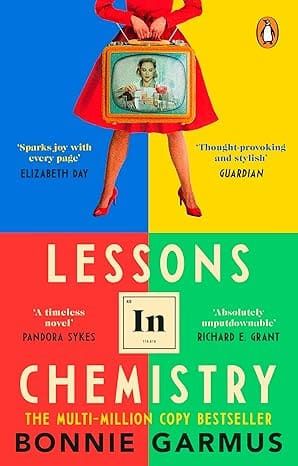
Lessons in Chemistry
Early-1960s Southern California: chemist Elizabeth Zott is smarter than the men who keep calling her a secretary, and she will be the first to tell you there is no such thing as an average woman. At Hastings Research Institute she finds one colleague who actually reads her work — Calvin Evans, a Nobel-nominated grudge-holder with a dog-shaped hole in his idea of family — and then life does what unrepeatable experiments do. A few years later she is a single mother, a rowing-club regular, and the deadpan star of America's favorite cooking show, where vinegar is acetic acid and the real recipe is telling women to stop shrinking. Funny, furious, and occasionally a little too neat, it is a book club novel about credit, kitchens, and who gets to take themselves seriously.
“Children, set the table. Your mother needs a moment to herself.”
Complete free book club kit
BookClubee may earn a commission from Bookshop.org purchases, which supports independent bookshops.
Plan your meeting
Spoiler warning — best after finishing the book
Lessons in Chemistry Discussion Questions
20 free questions written for Lessons in Chemistry. No obvious right answers — built to spark real disagreement.
1. Calvin proposes in the Hastings cafeteria and Elizabeth says no, because marriage would put her work in his name. Do you read that as a hard-headed career decision, a lack of trust in him, or both?
Warm Up
2. Calvin's first words to Elizabeth, when she is taking surplus beakers from his lab, assume she is a secretary. After everything that follows, does that opening make him more human — or just another man breathing the institute's air?
Warm Up
3. On Supper at Six, Elizabeth calls vinegar acetic acid and salt sodium chloride. Is she teaching chemistry, refusing to dumb herself down, or both — and did that choice respect her audience or talk past them?
Warm Up
4. Harriet Sloane knocks on the door and never really leaves. Is she the book's argument that family is whoever shows up — or a convenience the plot needs a little too much?
Warm Up
5. Six-Thirty understands English, keeps a vocabulary, and talks to the baby who is not born yet. Did that point of view win you immediately, or did it knock you out of an otherwise grounded novel?
Warm Up
6. Elizabeth alters Mad's birth certificate so she can start kindergarten early. Is that a mother solving an impossible childcare problem — or the same rule-breaking she condemns when men do it for worse reasons?
Debate Starter
7. After Calvin dies, Donatti uses Elizabeth's pregnancy as the excuse to fire her. If she had kept her head down longer, would she have kept a lab — or is that the bargain the book wants you to refuse?
Debate Starter
8. On the first live broadcast, Elizabeth ignores Walter Pine's cue cards. Integrity on air — or someone using a station's money and a producer's panic to make a private point?
Debate Starter
9. When Phil Lebensmal tries to assault her, Elizabeth pulls a kitchen knife from her bag and he collapses. Does the scene take the violence seriously, or does the dark comedy around it let the book off the hook?
Debate Starter
10. Life magazine turns Franklin Roth's serious profile into a 'Luscious Lizzie' piece; Vogue later runs what he actually wrote. Who failed Elizabeth more: one editor, or a culture that wanted the nickname?
Debate Starter
11. Optimists say Supper at Six really does change the women watching. Pessimists say a chemist ending up in a TV kitchen is still the old trap in a new apron. Which reading does the novel earn?
Debate Starter
12. Optimists call Avery Parker arriving with money, a job, and a grandmother a hard-won reunion. Pessimists call it a fairy godmother. After the last chapters, which side has the stronger case?
Debate Starter
13. Optimists say refusing Calvin's name protected Elizabeth's work. Pessimists say it also denied him, and later Mad, a legal family for a principle. After his death, does her reasoning still hold?
Debate Starter
14. Is Dr. Donatti a uniquely awful boss, or a man the institute trained to steal credit and call it leadership? Does firing him actually change Hastings?
Debate Starter
15. Elizabeth did not want children, then builds a life around Mad. Does the novel respect that contradiction — or solve it by turning her into a more devoted mother than she claimed she would be?
Deep Dive
16. Men at Hastings quietly take Elizabeth's notes, her methods, and then her papers. Looking at labs, offices, and group chats today, what has actually changed besides the dress code?
Deep Dive
17. "Children, set the table. Your mother needs a moment to herself." Is that a feminist sign-off — or does it still assign the table to the children and the kitchen to Mom?
Deep Dive
18. Mad wants to fit in because her mother never did. What does the book think a child owes a parent's refusal to play along — loyalty, distance, or a different experiment?
Deep Dive
19. Reverend Wakely and Calvin's old letters put science and faith in the same mailbox. Does the novel actually argue with belief, or does it stack the deck for the chemist every time?
Deep Dive
20. Harriet, Six-Thirty, Walter, Frask, and later Avery become a household that blood relatives never managed to be. Is "family is who shows up" enough for this book — or does it still hunger for the parent Calvin never got to meet?
Deep Dive