← Books
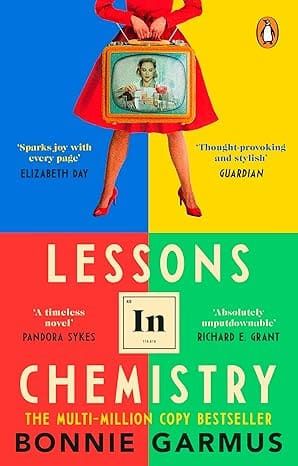
Cover of Lessons in Chemistry by Bonnie Garmus

Historical Fiction · Free kit

Lessons in Chemistry

Bonnie Garmus

Early-1960s Southern California: chemist Elizabeth Zott is smarter than the men who keep calling her a secretary, and she will be the first to tell you there is no such thing as an average woman. At Hastings Research Institute she finds one colleague who actually reads her work — Calvin Evans, a Nobel-nominated grudge-holder with a dog-shaped hole in his idea of family — and then life does what unrepeatable experiments do. A few years later she is a single mother, a rowing-club regular, and the deadpan star of America's favorite cooking show, where vinegar is acetic acid and the real recipe is telling women to stop shrinking. Funny, furious, and occasionally a little too neat, it is a book club novel about credit, kitchens, and who gets to take themselves seriously.

“Children, set the table. Your mother needs a moment to herself.”

Complete free book club kit

BookClubee may earn a commission from Bookshop.org purchases, which supports independent bookshops.

Plan your meeting

Reading schedule · Book vote

Lessons in Chemistry Characters

Spoiler-aware but intrigue-first.

Elizabeth Zott

The chemist who will not smile on cue, even when the cameras are rolling.

The Vibe
Elizabeth is the person who answers a social question with a fact, wears a number-two pencil in her hair like a weapon and a tool, and cannot pretend a bad experiment is a good one. She cooks the way she labs: repeatedly, precisely, and without any interest in whether you find that charming. People keep trying to make her smaller. She keeps measuring.
Their Contradiction
On the surface: Cool, uncompromising, apparently allergic to small talk. Underneath: She is starving for one person who will take her mind as the main event — and terrified of what happens if they do.
Why Readers Love / Hate Them
You will want her at your dinner party until she starts naming the acetic acid, at which point half the table will fall in love and the other half will ask her to please just pass the salt.
Most Revealing Moment
Watch what she does the first time a man hands her cue cards and assumes she will read them.
Book Club Hot Take
Is Elizabeth brave — or is she someone who never learned the social grease that makes other people's lives easier, and called that a moral stance?

Calvin Evans

The famous chemist who falls in love with her brain and still trips over the rest of her.

The Vibe
Calvin is brilliant, lonely, and carrying a childhood he would rather row away from than discuss. He has the lab, the reputation, and the emotional range of someone who learned early that people leave. Then Elizabeth walks in for beakers, and he has to decide whether genius includes listening.
Their Contradiction
On the surface: A Nobel-nominated star who does not need anyone. Underneath: He wants a family so badly he can barely say the word, and he keeps proposing the one institution that would cost Elizabeth her name.
Why Readers Love / Hate Them
Readers tend to adore him — which is useful, because it makes his blind spots harder to excuse.
Most Revealing Moment
Watch him in the cafeteria when Elizabeth will not become Mrs. Calvin Evans. The love is real. So is the confusion.
Book Club Hot Take
Does Calvin actually see Elizabeth as an equal, or does he love her in the way gifted men often do — as the exception that proves the rest of the rule?

Madeline "Mad" Zott

The child who is trying to build a normal life out of extraordinary materials.

The Vibe
Mad is precocious without being a mascot: she wants friends, a family tree that makes sense, and a mother who does not have to be a public argument. She packs lunches that other children steal, asks questions adults dodge, and notices that "Luscious Lizzie" is a nickname designed to make her mother smaller.
Their Contradiction
On the surface: A tiny scientist-in-training raised on vocabulary and leftovers of grief. Underneath: Fitting in matters to her more than it has ever mattered to Elizabeth — and she has proof, because she has watched what not fitting in costs.
Why Readers Love / Hate Them
You may find her almost too capable for her age, then remember she has had to be.
Most Revealing Moment
Watch what she does with a school family-tree assignment when the official story has holes in it.
Book Club Hot Take
Is Mad the book's heart — or the device that forces Elizabeth to become the mother she said she never wanted to be?

Six-Thirty

The dog who understands English and takes the job of family more seriously than most of the humans.

The Vibe
A former Marine explosives dog who followed Elizabeth home at 6:30 and declined to leave. He has opinions, a growing vocabulary, and a sense of duty that would be funny if it weren't also the novel's most reliable moral compass. He is not comic relief. He is the witness.
Their Contradiction
On the surface: A miraculously literate pet in a book that otherwise worships the scientific method. Underneath: He is the novel's argument that loyalty can be trained, chosen, and practiced — and that some families start as strays.
Why Readers Love / Hate Them
If you do not love him, the rest of the club will want a word.
Most Revealing Moment
Watch how he behaves around the people he has decided are his. He does not do this by accident.
Book Club Hot Take
Does Six-Thirty's inner life make the book more moving — or is he a cheat code for emotion the human scenes should have earned alone?

Harriet Sloane

The neighbor who knocks, stays, and quietly becomes load-bearing.

The Vibe
Harriet has the energy of someone who has already made coffee, noticed what you need, and is not going to make a speech about it. She has her own house next door, her own reasons for wanting to be elsewhere, and a talent for turning other people's emergencies into a life she can stand.
Their Contradiction
On the surface: The helpful neighbor, endlessly available. Underneath: Helping Elizabeth and Mad is also how she gets a family she was not being offered at home.
Why Readers Love / Hate Them
Readers tend to protect Harriet on sight — and may still wonder whether the book uses her kindness as a shortcut.
Most Revealing Moment
Watch what she does the first time Mad needs a grown-up who is not Elizabeth and not a theory.
Book Club Hot Take
Is Harriet saintly, or is she doing the smartest thing available to a woman with nowhere else to put her love?

Walter Pine

The TV producer who hired a chemist and then had to live with her.

The Vibe
Walter is not a villain and not a hero: he is a man with a daughter, a boss, cue cards, and a show that will die if Elizabeth will not play along. He keeps trying to split the difference between the station's idea of a woman and the actual woman in front of the camera.
Their Contradiction
On the surface: A nervous professional trying to keep his job. Underneath: He recognizes that Elizabeth is the most interesting person in the building — and still asks her to be smaller because that is what the men upstairs bought.
Why Readers Love / Hate Them
You may forgive him faster than Elizabeth would, which is worth noticing.
Most Revealing Moment
Watch him after the cue cards fail and the audience leans in anyway. Does he become braver, or just better at riding a hit?
Book Club Hot Take
Is Walter an ally who grows — or proof that even the "good" men need the ratings to get there?

Miss Frask

The Hastings staffer who starts as an obstacle and becomes something much more useful.

The Vibe
Frask is the person who enforces the institute's pettiness until you realize she has been surviving inside it. She knows where the files are. She knows what the men did. She has her own unfinished degree and her own reasons for being sharp with Elizabeth.
Their Contradiction
On the surface: Hostile personnel energy in a bad suit. Underneath: She and Elizabeth have more biography in common than either of them wanted to admit.
Why Readers Love / Hate Them
The turn from irritant to ally is one of the book's quieter satisfactions — or, if you are ungenerous, one of its tidier conversions.
Most Revealing Moment
Watch what she does with Calvin's files when she no longer has a reason to protect the people who discarded her.
Book Club Hot Take
Does Frask change because she grows a conscience — or because the institute finally does to her what it had already done to Elizabeth?

Character Dynamics Map

The engine is Elizabeth and Calvin: two people who recognize each other's minds faster than they recognize what the world will do to a woman standing next to a famous man. Around them, Hastings is a machine for stealing credit, and the cafeteria proposal is the first time love and authorship occupy the same table. After that, the household that actually works is the unofficial one — Mad, Six-Thirty, and Harriet — while Walter tries to package Elizabeth for television without quite erasing her. Frask sits on the hinge between those worlds: she has enforced the institute's rules, and she has also been broken by them. The book-club question underneath all of it: who is allowed to take up space, and who has to call that space a kitchen before anyone will listen?

Superlatives

Award categories built to spark arguments (in a good way).

  • Most Likely to Correct Your Recipe Using IUPAC Nomenclature

    Winner: Elizabeth Zott

    She tells a national audience to combine acetic acid and sodium chloride, then keeps going as if this is simply how adults talk about dinner.

    Close second: Madeline Zott

    Do you agree, or would you have picked Mad, who was raised on this vocabulary?

  • Most Likely to Propose at Work and Be Genuinely Confused by the Word No

    Winner: Calvin Evans

    He asks in the Hastings cafeteria, as if marriage were a simple joint appointment, and cannot quite hear that the name change is the whole problem.

    Close second: Walter Pine

    Do you agree, or is Walter's on-air packaging of Elizabeth its own kind of unwanted proposal?

  • Most Likely to Follow You Home at 6:30 and Reorganize Your Entire Life

    Winner: Six-Thirty

    He arrives as a stray at a specific time, accepts the name that records it, and then appoints himself family.

    Close second: Harriet Sloane

    Do you agree, or did Harriet's knock on the door change more practical things than the dog did?

  • Most Likely to Turn a School Project Into a Missing-Persons Case

    Winner: Madeline Zott

    A family-tree assignment sends her after Calvin's orphanage, Reverend Wakely, and a donor whose name does not belong on a homework sheet.

    Close second: Reverend Wakely

    Do you agree, or does Wakely's old correspondence with Calvin do more of the detective work?

  • Most Likely to Steal Your Lunch and Accidentally Launch a Television Career

    Winner: Amanda Pine

    She eats Mad's scientifically packed lunch; Elizabeth goes to the station to discuss it; Walter hires a chemist.

    Close second: Walter Pine

    Do you agree, or is Walter the one who turned a parent complaint into Supper at Six?

  • Most Likely to Wear a Number-Two Pencil as Both Accessory and Exit Strategy

    Winner: Elizabeth Zott

    The pencil is in her hair at Hastings, in the kitchen, and — in the UCLA backstory — already proven as more than stationery.

    Close second: Madeline Zott

    Do you agree, or is Mad the one who actually uses paper and pencil to rewrite the family story?

  • Most Likely to Ignore the Cue Cards on Live Television

    Winner: Elizabeth Zott

    Walter writes them; she declines; the audience prefers the chemist. The show never really recovers from being honest.

    Close second: Six-Thirty

    Do you agree, or is the dog the book's other creature who simply will not perform as directed?

  • Most Likely to Take Credit for Work They Could Not Have Designed

    Winner: Dr. Donatti

    He keeps Elizabeth on menial labor, then plagiarizes her research — the Hastings special in one person.

    Close second: Dr. Boryweitz

    Do you agree, or are the smaller thefts around the lab even more typical of the place?

  • Most Likely to Become Family Without Anyone Filing Paperwork

    Winner: Harriet Sloane

    She starts as the neighbor with a casserole-shaped offer of help and ends as the extra adult Mad actually has.

    Close second: Six-Thirty

    Do you agree, or is the dog the more permanent adoption?

  • Most Likely to Have a Grudge With Its Own Filing System

    Winner: Calvin Evans

    The book introduces him as a Nobel-nominated grudge-holder, and his childhood at All Saints explains why he keeps score.

    Close second: Elizabeth Zott

    Do you agree, or does Elizabeth's grudge against a whole society outrank his?

  • Most Likely to Row Before Dawn and Call It Character Building

    Winner: Calvin Evans

    He talks Elizabeth onto the water, then onto the erg, in a sport the club still treats as a men's club.

    Close second: Dr. Mason

    Do you agree, or is Mason — obstetrician and coach — the one who makes rowing a life raft later?

  • Most Likely to Publish "Luscious Lizzie" and Pretend It Was Journalism

    Winner: Life magazine's editor

    Franklin Roth writes a serious piece; the published version sells a nickname and a figure, not a chemist.

    Close second: Phil Lebensmal

    Do you agree, or did Lebensmal's vision for a sexy cooking show do the same violence first?

  • Most Likely to Survive Hastings by Knowing Where the Files Are

    Winner: Miss Frask

    Before she is pushed out, she hands Elizabeth Calvin's research files — the most useful thing anyone at that institute does.

    Close second: Elizabeth Zott

    Do you agree, or is Elizabeth the one who actually knows what is in the files?

  • Most Likely to Fund a Boys' Home for Reasons That Are Not in the Brochure

    Winner: Avery Parker

    The money that kept reaching All Saints was not random philanthropy; it was a mother looking for a son she had been told was gone.

    Close second: The bishop at All Saints

    Do you agree, or does the bishop's lie about Calvin's death deserve the darker award?

  • Most Likely to End Your Show With a Sentence That Is Also a Political Program

    Winner: Elizabeth Zott

    "Children, set the table. Your mother needs a moment to herself" is a sign-off, a boundary, and a dare in one breath.

    Close second: Harriet Sloane

    Do you agree, or did Harriet's "take a moment for yourself" speech invent the line before television did?