
Historical Fiction · Free kit
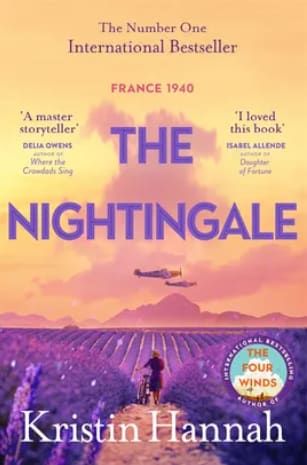
The Nightingale
Occupied France, 1939 to 1945: two Rossignol sisters, years and temperament apart, take different roads through the same war. Vianne Mauriac stays in the garden house at Carriveau with her daughter Sophie after her husband Antoine is taken prisoner, and learns what it costs to keep a child alive with German officers in the spare room. Isabelle, expelled and hungry to be useful, walks into the Resistance and becomes the Nightingale — the passeur who leads Allied airmen over the Pyrenees. Hannah braids their choices with a 1995 Oregon frame: an elderly woman, a trunk, an identity card that says Juliette Gervaise, and the question of which sister's war the people who love her were ever allowed to know.
“If I have learned anything in this long life of mine, it is this: In love we find out who we want to be; in war we find out who we are.”
Complete free book club kit
BookClubee may earn a commission from Bookshop.org purchases, which supports independent bookshops.
Plan your meeting
Spoiler warning — best after finishing the book
The Nightingale Discussion Questions
20 free questions written for The Nightingale. No obvious right answers — built to spark real disagreement.
1. Isabelle meets Gaëtan on the refugee road out of Paris and is sure they will resist together. He leaves a note that she is not yet ready for war. At that point in the book, is he protecting her — or deciding for her?
Warm Up
2. Beck is polite, helps with a letter to Antoine, and still asks Vianne for the names of Jewish teachers at her school. After that scene, can courtesy and occupation sit in the same man without one canceling the other?
Warm Up
3. Isabelle tricks Beck into a travel pass by claiming her father is sick, then uses Paris to become a courier and later a passeur. Was that the moment she stopped being Vianne's problem child and started being a combatant?
Warm Up
4. The Rossignol family name already means nightingale. When Isabelle takes the code name, is she inventing a new self — or finally wearing the name her father would not claim with her?
Warm Up
5. In 1995 the Oregon attic holds a French identity card for Juliette Gervaise. Before the reunion, whose war did you think you were sitting in — and what did that assumption say about which sister the book trained you to call a hero?
Warm Up
6. Vianne writes the Jewish-teacher list because Beck promises a care package for Antoine. Does that bargain make her complicit in Rachel's firing, or does occupation make every "choice" a hostage situation?
Debate Starter
7. When Isabelle hides the wounded American airman in the barn at Le Jardin, Vianne condemns her for risking Sophie. If you had been the sister in the kitchen, whose fear would you have trusted?
Debate Starter
8. Beck dies in that barn: Vianne hits him with a shovel, Isabelle fires, and both women are marked by it. Is Beck's death a tragedy the book earned, or the moment it needed the "good German" out of the way?
Debate Starter
9. Julien Rossignol tells the Nazis he is the Nightingale so Isabelle might live, and they execute him. Was that the first honest fathering he does — or a final performance that still leaves her to Ravensbrück?
Debate Starter
10. Vianne hides Ari as Daniel, then later works with the Mother Superior to place nineteen Jewish children in the orphanage under false names. Is forging a child's name an act of love, an act of erasure, or both at once?
Debate Starter
11. After the war, relatives in America claim Ari. Vianne has raised him and still sends him. Optimists call that returning him to his people; pessimists call it a second abandonment. Which reading fits what the novel actually shows?
Debate Starter
12. Antoine comes home a stranger. Vianne does not tell him she is pregnant by Von Richter. Is silence here a kindness to a marriage, or a lie that will structure the rest of Julien's life?
Debate Starter
13. Optimists might say Vianne's quiet work — papers, the convent, enduring Von Richter to protect the children — is the novel's real resistance. Pessimists might say the book only lets her be brave once Isabelle has already defined courage as mountains and guns. Which side has the stronger case?
Debate Starter
14. The 1995 reunion honors passeurs; Vianne speaks for Isabelle, who died shortly after the camps. Does the ending give Isabelle the recognition the war withheld — or does it still make Vianne the keeper of someone else's legend?
Debate Starter
15. Sarah is killed by stray fire at the checkpoint while Vianne is trying to walk Rachel's family toward the Free Zone. After that failure, Vianne still takes Ari home. What does the book ask us to do with a rescue that cannot save everyone it touches?
Deep Dive
16. Today, people still hide neighbors, forge papers, and argue about who counts as "doing enough" in a crisis. Does Vianne's list-then-later-courage feel like a warning about early compliance, or a portrait of how moral courage sometimes arrives late and still matters?
Deep Dive
17. Isabelle wanted to be loved and admired; by the end she would rather be known. In a culture that still posts the highlight reel, is "being known" a better wish — or just a lonelier one?
Deep Dive
18. Vianne tells her son Julien a great deal at the Paris reunion and still withholds the truth of his paternity. Where is the line between a mother's right to a private wound and a child's right to an accurate origin?
Deep Dive
19. Hannah has said Isabelle's escape line was inspired by Andrée de Jongh and the Comet Line. Does knowing a real passeur walked those mountains change how you judge the novel's sentiment — or does the fiction still have to earn its tears on its own pages?
Deep Dive
20. Men tell stories; women get on with it, the book suggests. After watching both sisters, do you buy that split — or do Vianne and Isabelle prove that getting on with it is also a story the official record was not built to hold?
Deep Dive