
Literary Fiction · Free kit
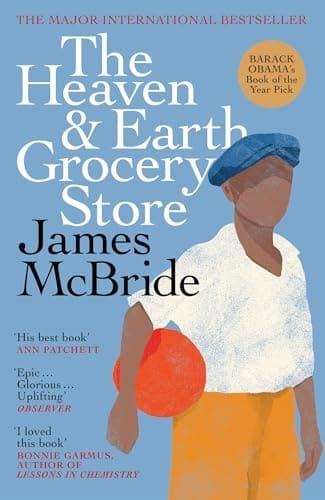
The Heaven & Earth Grocery Store
In 1972, workers digging on Chicken Hill in Pottstown, Pennsylvania, find a skeleton at the bottom of a well — and a mezuzah that does not belong with a body. James McBride winds the story back to the 1920s and '30s, when Jewish immigrants and African Americans shared the hill, Moshe Ludlow booked jazz into his theater, and Chona Ludlow kept the Heaven & Earth Grocery Store open as the neighborhood's stubborn heartbeat. When the state comes for Dodo, a Deaf boy in Nate and Addie Timblin's care, the hill has to decide what a neighbor is worth. Funny, crowded, and unsparing about who America protects.
“To her, the world was not a china closet where you admire this and don't touch that. Rather, she saw it as a place where every act of living was a chance for tikkun olam, to improve the world.”
Complete free book club kit
BookClubee may earn a commission from Bookshop.org purchases, which supports independent bookshops.
Plan your meeting
Spoiler warning — best after finishing the book
The Heaven & Earth Grocery Store Discussion Questions
20 free questions written for The Heaven & Earth Grocery Store. No obvious right answers — built to spark real disagreement.
1. Moshe wants to leave Chicken Hill for a nicer house downtown; Chona tells him he can have his deposit back, or she can visit. Before the plot turns on Dodo, whose idea of 'our people' did you find easier to live with?
Warm Up
2. Chona keeps the Heaven & Earth Grocery Store open even though it loses money. Is the store a business, a ministry, or a refusal to let the hill become someone else's problem?
Warm Up
3. Moshe books Mickey Katz, then Chick Webb, and notices that 'cripples have brought me fortune: Moses, Chona, and Chick.' Did that line read as love, superstition, or a man still measuring people by what they do for him?
Warm Up
4. Paper collects everybody's business and still helps get Dodo out. In this book, is gossip a vice, a neighborhood utility, or both?
Warm Up
5. Dodo is Deaf, sharp, and constantly talked over. Which early scene first convinced you the adults were the ones who could not hear?
Warm Up
6. Nate and Addie ask Moshe and Chona to hide Dodo from the state rather than fight Pennhurst in court. Protection of a child, a reasonable reading of what 'special school' meant in 1930s Pennsylvania, or a choice that put Chona in Doc Roberts's path?
Debate Starter
7. Moshe's cousin Isaac offers a lawyer; Nate says the law is whatever the white man says it is. After Pennhurst, whose strategy do you trust — and would your answer change if Dodo had been a hearing white child?
Debate Starter
8. Chona will not stop writing and talking about Doc Roberts's Klan parade. Is that courage the hill needed, or a publicity that made Dodo easier to find?
Debate Starter
9. When Chona seizes in the store, Doc assaults her and Dodo attacks him. Do you read Dodo's violence as the only language the town would understand, or as the moment the state got the excuse it wanted?
Debate Starter
10. Nate kills Son of Man while getting Dodo out of Pennhurst. Necessary protection of the next boy, the return of the violence Nate has been trying to outrun, or both — and does 'both' let anyone off the hook?
Debate Starter
11. Doc Roberts ends up in the uncovered well after Henry Lit mistakes him for Gus Plitzka. Optimists may call it justice arriving by the back door. Pessimists may call it a coincidence McBride dresses up as fate. Which reading fits the mezuzah in Doc's fist?
Debate Starter
12. The shul's water has been stolen and then stolen back: Plitzka drained the well for Clover Dairy; Fatty and Big Soap tap the city line. Is that neighborhood self-help, a preview of who actually owns Pottstown's infrastructure, or a crime you would not forgive if the dairy had been on Chicken Hill?
Debate Starter
13. Optimists may say Chicken Hill's Jewish and Black residents prove America can be a shared table. Pessimists may say the alliance holds because Chona is extraordinary, and that most of the Jews have already moved downtown. Which version does the book actually argue?
Debate Starter
14. Hurricane Agnes washes the well, the skeleton, and the evidence into the Manatawny and out to sea, and spares Chicken Hill. Too neat a moral weather report — or McBride telling you, on purpose, that history does not always file a complete police report?
Debate Starter
15. Pennhurst is a real Pennsylvania institution, and Dodo is sent there because he is Deaf, not because he is 'insane.' Where do you still see a version of that swap — a system that treats difference as a problem to warehouse — and who gets to call the warehouse a school?
Deep Dive
16. Chona sees Black neighbors as neighbors, not as a cause. Moshe loves Nate and still feels 'a space between them.' In your town now, what is the difference between friendship that costs you something and friendship that is mostly good manners?
Deep Dive
17. McBride gives Dodo a last breath — 'Thank you, Monkey Pants' — that his own family cannot decode. What does it mean that the person who saved him inside Pennhurst is untranslatable to the people who love him later?
Deep Dive
18. The mezuzah says 'Home of the Greatest Dancer in the World,' travels from Moshe to Malachi to Chona to Doc to the well, and greets the state troopers in 1972. Is it a blessing, a joke, evidence, or McBride's way of saying Jewish life — and Black life on the hill — will not stay put for a museum?
Deep Dive
19. Moshe and Isaac later found Camp Chona for disabled children. Is that a fitting memorial, a rich man's repair, or the book admitting that individual camps cannot replace what Pennhurst was built to do?
Deep Dive
20. The title yokes heaven and earth to a grocery that barely breaks even. After the well, the camp, and Nate Love II's farm, do you think McBride believes community can save people — or only that it can hide them long enough to live?
Deep Dive