
Historical Fiction · Free kit
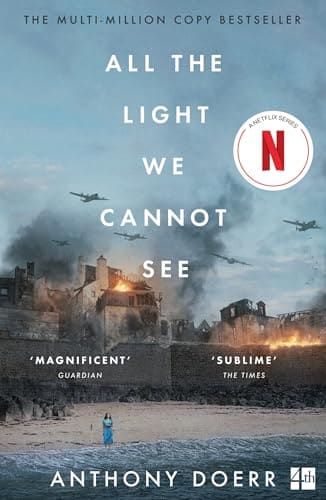
All the Light We Cannot See
A blind Parisian girl learns cities by touch; a German orphan learns the world through a repaired radio. As occupation closes over France and a coal-town childhood is traded for a Nazi school, Marie-Laure LeBlanc and Werner Pfennig move toward the same walled Breton port — and toward a diamond the size of a legend. Doerr's 2014 Pulitzer winner is built from short, sensory chapters: snails, static, miniature streets, and the question of how to stay curious, and decent, inside a machine designed to punish both.
“Open your eyes and see what you can with them before they close forever.”
Complete free book club kit
BookClubee may earn a commission from Bookshop.org purchases, which supports independent bookshops.
Plan your meeting
Spoiler warning — best after finishing the book
All the Light We Cannot See Discussion Questions
20 free questions written for All the Light We Cannot See. No obvious right answers — built to spark real disagreement.
1. Daniel builds Marie-Laure a scale model of Paris, then of Saint-Malo, so she can walk the real streets by memory. Is that primarily a father's love — or a way of keeping the world small enough that he can still control it?
Warm Up
2. Werner and Jutta find a broken radio and hear a Frenchman talk about light, snails, and the brain. Before Schulpforta, what do those nights actually give Werner: a vocation, an escape hatch, or a story he will later use to excuse himself?
Warm Up
3. Marie-Laure is twelve when she and Daniel flee Paris with a stone nobody will name. At that point in the book, do you read her blindness as the novel's metaphor engine — or as a practical fact the plot then has to honor?
Warm Up
4. Etienne has not left Number 4 rue Vauborel in years, yet his transmitter already reaches an orphanage in Zollverein. Is a man who broadcasts the world while refusing the street a coward, a survivor of 1918, or both without contradiction?
Warm Up
5. The museum sends out three copies of the Sea of Flames and keeps a fourth. Daniel never tells Marie-Laure which one he is carrying. Should a parent share a danger that size, or is silence part of the locksmith's job?
Warm Up
6. Werner accepts Schulpforta to escape the mines that killed his father. Jutta hears French reports of German crimes and begs him not to go. After everything that follows, whose reading of that choice was more accurate — and does accuracy matter if the mines were still waiting?
Debate Starter
7. Frederick refuses to throw a bucket of water on a prisoner and is beaten until his mind is not his. Werner does not stop it. Is Werner's silence in that yard the novel's true indictment of him, or proof that one boy's body cannot veto a school?
Debate Starter
8. Madame Manec organizes old women, bread loaves, and small sabotage while Etienne still will not leave the house. When she asks him to be useful, is she right that fear has become a luxury — or is she asking a shell-shocked man to relive the war that already broke him?
Debate Starter
9. Werner traces the Saint-Malo broadcast, recognizes the professor from Zollverein, and does not report the house. Optimists call that the return of his soul. Pessimists call it a private exception after months of hunting other transmitters. Which case is stronger?
Debate Starter
10. Werner's unit kills a woman and a child after he traces the wrong signal. He stays in the truck. Does that scene make later rescue in Saint-Malo feel like redemption — or like a ledger that cannot be balanced by one good night?
Debate Starter
11. Marie-Laure takes the diamond from the model house and, after the siege, leaves it in the sea grotto. Was that breaking a curse, refusing a museum's greed, or discarding the one object that might have explained her father's arrest?
Debate Starter
12. Werner and Marie-Laure share only hours: a can of food, a key, a walk toward the ramparts. Some readers feel cheated; some feel the brevity is the point. Did Doerr earn that short meeting, or did ten years of braiding two lives promise a conversation the book then withholds?
Debate Starter
13. Werner dies in a prisoner-of-war camp by stepping on a German mine in delirium. Is that historically honest chance — or a novel punishing the character it spent four hundred pages teaching you to forgive?
Debate Starter
14. Von Rumpel is a gemologist with cancer who believes the stone will let him live. Next to Werner, he is almost a cartoon of Nazi appetite. Does the book need that simple villain so it can afford a complicated German boy — and is that a fair trade?
Debate Starter
15. In 1974 Jutta brings Marie-Laure the little house and a story that Werner may have been in love. Marie-Laure is a marine biologist with a life that continued. What should a survivor owe the family of someone who saved her for one night and then vanished?
Deep Dive
16. The title points at the electromagnetic spectrum: radio, light we cannot see, voices traveling without bodies. In a decade of phones, drones, and wartime livestreams, does Doerr's miracle of connection still feel wondrous — or has invisible communication become another occupation tool?
Deep Dive
17. Marie-Laure's war is touch, smell, tide, and a cane; Werner's is frequencies and orders. The novel insists both are ways of knowing. After finishing, whose way of seeing the war do you trust more — and what does that say about which kind of evidence you usually believe?
Deep Dive
18. Doerr has said he wanted civilians, not charismatic résistants and cartoon Nazis. Saint-Malo is still rebuilt on the page as a fairy-tale fortress, and the diamond still behaves like a fable. Does the lyricism honor the dead of 1944, or does it sand occupation into something prettier than it was?
Deep Dive
19. Etienne finally broadcasts numbers for the Allies because Marie-Laure and Madame Manec's work leave him no honest way to stay upstairs. Is late courage still courage, or does waiting until the housekeeper is dead make his heroism a debt he is paying, not a choice he made?
Deep Dive
20. The last pages jump to 2014: Marie-Laure is eighty-six, walking Paris with her grandson Michel, thinking of waves of information in the air. After a novel so crowded with the dead, is that coda earned peace — or a comfort the middle of the book did not actually buy?
Deep Dive