← Books
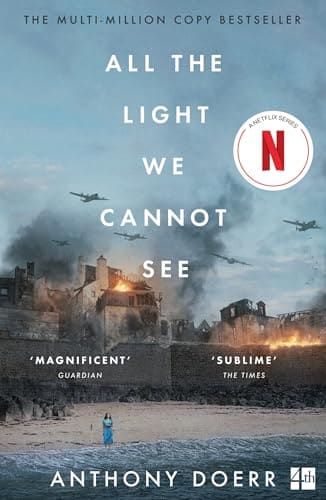
Cover of All the Light We Cannot See by Anthony Doerr

Historical Fiction · Free kit

All the Light We Cannot See

Anthony Doerr

A blind Parisian girl learns cities by touch; a German orphan learns the world through a repaired radio. As occupation closes over France and a coal-town childhood is traded for a Nazi school, Marie-Laure LeBlanc and Werner Pfennig move toward the same walled Breton port — and toward a diamond the size of a legend. Doerr's 2014 Pulitzer winner is built from short, sensory chapters: snails, static, miniature streets, and the question of how to stay curious, and decent, inside a machine designed to punish both.

“Open your eyes and see what you can with them before they close forever.”

Complete free book club kit

BookClubee may earn a commission from Bookshop.org purchases, which supports independent bookshops.

Plan your meeting

Reading schedule · Book vote

All the Light We Cannot See Characters

Spoiler-aware but intrigue-first.

Marie-Laure LeBlanc

The girl who learns Paris and the sea by fingertip.

The Vibe
Blind at six, stubborn about snails, Braille, and getting down the stairs without being treated like glass. Marie-Laure is not a symbol who happens to live in Saint-Malo; she is a person who wants the names of mollusks and a way home that does not require anyone's arm. War arrives as sound, smell, and a cane on cobbles.
Their Contradiction
On the surface: Sheltered, led, the locksmith's careful daughter. Underneath: Someone who will walk a walled city alone, open a puzzle her father never explained, and decide what the ocean is owed.
Why Readers Love / Hate Them
Easy to love and easy to over-praise. Clubs should notice when they call her purely brave — she keeps saying the work is just how she lives.
Most Revealing Moment
Watch her in the grotto at low tide, collecting shells as if occupation were weather she refuses to let rename the sea.
Book Club Hot Take
If Marie-Laure could see, would this still be her novel — or does the book need her blindness more than she does?

Werner Pfennig

The orphan whose gift for radios becomes a uniform.

The Vibe
White hair, white mind, a boy who can hear a dead wireless back to life in a coal-town children's home. Werner wants laboratories, not mines, and he is young enough to believe a school that loves his talent will also love him. The Reich is very good at that sentence.
Their Contradiction
On the surface: Gentle, curious, the child who shares bread and science lectures with Jutta. Underneath: A technician who keeps saying yes until the yes is a truck, a rifle, and a frequency he is supposed to erase.
Why Readers Love / Hate Them
Readers protect him, then feel sick about protecting him. That discomfort is the assignment, not a glitch.
Most Revealing Moment
Watch him the first time someone at Schulpforta asks him to locate a signal and he understands the prize is not knowledge.
Book Club Hot Take
Is Werner a victim of a machine, or a boy who kept choosing the machine because it called him special?

Daniel LeBlanc

The museum locksmith who builds cities his daughter can hold.

The Vibe
A widower with keys, glue, and a private terror that the world will become a maze Marie-Laure cannot solve. He turns Paris into wood, then Saint-Malo into wood, and hides a museum problem inside a toy. Love, for him, looks like homework you can run your hands over.
Their Contradiction
On the surface: The safest adult in the book — puzzles, birthday boxes, patient drills. Underneath: A man carrying a stone that, if the stories are true, purchases her life with everyone else's.
Why Readers Love / Hate Them
Admiration first, then an argument about whether a good father had any right to bring that diamond into a child's house.
Most Revealing Moment
Watch him measuring Saint-Malo's streets for the model — useful, devoted, and already looking like a man the occupation can accuse of mapping.
Book Club Hot Take
Did Daniel protect Marie-Laure, or did he turn her childhood into the hiding place for a national treasure?

Etienne LeBlanc

The great-uncle who already fought one war from an attic.

The Vibe
Number 4 rue Vauborel, recordings of a dead brother, a transmitter behind a wardrobe, and a man who hears 1918 in every slammed door. Etienne can describe the cosmos and still be unable to buy bread. Then a blind great-niece arrives and the house has to decide whether it is a tomb or a station.
Their Contradiction
On the surface: Agoraphobic, eccentric, the relative you manage rather than follow. Underneath: The voice that once taught science to children hundreds of miles away — including two German orphans who did not know his name.
Why Readers Love / Hate Them
Pity is too small. Clubs either want to shake him into the street or admit they would also stay upstairs.
Most Revealing Moment
Watch him when Madame Manec asks him to use the radio for something other than ghosts.
Book Club Hot Take
Is Etienne's later usefulness proof that love cures fear — or proof that the women in the house did the courage first?

Madame Manec

The housekeeper who treats occupation as a kitchen problem.

The Vibe
Brisk, old, already running Etienne's life before the Germans arrive. She cooks, organizes, and then organizes again: old women, loaves, information. She does not wait for a code name. She waits for Etienne to stop calling danger a reason to stay home.
Their Contradiction
On the surface: Domestic, disposable in the way literature often treats staff. Underneath: The first résistant in the house, and the one who dies before the attic becomes famous.
Why Readers Love / Hate Them
Readers fall for her immediately and then notice the novel spends more pages on men with radios. Hold that irritation.
Most Revealing Moment
Watch her recruit the ladies of Saint-Malo as if resistance were a committee meeting with better soup.
Book Club Hot Take
Is Madame Manec the book's actual moral center — and if so, why does the title still belong to light and boys?

Jutta Pfennig

The sister who keeps the radio honest.

The Vibe
Younger, sharper, less dazzled by being chosen. Jutta hears the same French lectures Werner does, then hears the news he would rather not. She is the conscience that does not get a laboratory or a truck. Zollverein keeps her; the war still writes on her.
Their Contradiction
On the surface: The leftover child at Children's House. Underneath: The only person Werner cannot fully lie to, even at a distance.
Why Readers Love / Hate Them
Easy to side with, harder to sit with: she is right early, and being right does not save her brother.
Most Revealing Moment
Watch her face when Werner accepts Schulpforta — not surprise, recognition.
Book Club Hot Take
If Jutta had been the radio genius, would the Reich have invented a school for her, or would the mines have taken her anyway?

Frederick

The bunkmate who would rather fail the test than become the test.

The Vibe
Thin, bird-mad, a Berlin boy who memorized the eye chart so a school of the body would take a boy of the mind. Frederick is Werner's proof that gentleness can enroll at Schulpforta. The school is Werner's proof that it cannot stay.
Their Contradiction
On the surface: Weak, inattentive, the one the yard will select. Underneath: The student who understood the assignment and refused it in public.
Why Readers Love / Hate Them
Love, then dread. Clubs use him as the saint Werner failed. Try also seeing him as a person, not Werner's missed exit.
Most Revealing Moment
Watch him with the bucket — the moment a birdwatcher becomes the only soldier in the room.
Book Club Hot Take
Is Frederick what Werner would have been without talent — or what Werner was too talented to remain?

Sergeant Major Reinhold von Rumpel

The gemologist who wants a diamond to outrun a diagnosis.

The Vibe
Patient, professional, traveling occupied Europe with a catalog and a tumor. Von Rumpel is the Reich as appetite: museums, vaults, a blue stone with a red core that the stories say will let its owner live. He is not curious about snails. He is curious about not dying.
Their Contradiction
On the surface: A fairy-tale hunter, almost too simple next to Werner. Underneath: A dying man whose greed is also panic, which does not make the hunting kind.
Why Readers Love / Hate Them
Hate is available and mostly correct. The club work is whether Doerr stacked the deck so Werner could look complicated.
Most Revealing Moment
Watch him in Marie-Laure's house during the siege, opening model rooms as if a child's toy were a vault.
Book Club Hot Take
Does von Rumpel exist as a person, or as the Nazi the book needs so it can ask you to pity a different German?

Character Dynamics Map

The novel's live wire is not a romance; it is two children taught to be useful by adults who cannot protect them. Marie-Laure's father builds her a city she can hold, then hides a museum's gamble inside it; Werner's teachers build him a future that runs on other people's frequencies. Around them, Etienne and Madame Manec fight a quieter war about whether a house is allowed to stay shut, while Jutta and Frederick keep failing to make Werner's talent mean goodness. Von Rumpel walks the same streets with a simpler hunger. When the boy with the radio and the girl with the cane finally occupy the same hours in Saint-Malo, the question is not whether they were destined to meet. It is whether a person who has been an instrument can still choose a single human voice in the static.

Superlatives

Award categories built to spark arguments (in a good way).

  • Most likely to turn love into a scale model

    Winner: Daniel LeBlanc

    Paris in wood, Saint-Malo in wood, birthday puzzle boxes — he cannot put the war in her hands, so he puts the streets there instead.

    Close second: Etienne, who keeps his dead brother alive as recordings in an attic

    Is a miniature city devotion, or a father making the world small enough to supervise?

  • Most likely to say yes to a school that will eat him

    Winner: Werner Pfennig

    Schulpforta is not a kidnapping. He wants the laboratories. The mines are the other door, and he knows it.

    Close second: Volkheimer, who already looks like the school's finished product

    If the mines were not waiting, would Werner still have gone — or is every yes in this book a hostage situation?

  • Best at resisting without a code name

    Winner: Madame Manec

    Old women, bread, information, a kitchen that becomes a cell. She dies before the transmitter is famous.

    Close second: Madame Ruelle, sliding paper into loaves as if treason were a bakery skill

    Whose resistance counts more: the attic that reaches London, or the errands that feed the attic?

  • Most likely to be right and still lose the argument

    Winner: Jutta Pfennig

    She hears the French reports, names what Werner is joining, and watches him leave anyway.

    Close second: Frederick, who names the bucket and pays in the yard

    Does the book treat Jutta as Werner's conscience, or as a full person the war also happened to?

  • Quietest act of treason in Saint-Malo

    Winner: Werner, not filing Etienne's signal

    After a career of finding illegal radios, he recognizes a childhood voice and keeps the house off the list.

    Close second: Etienne, finally sending numbers instead of science lectures

    Is Werner's silence heroism, or a private exception that does not refund the other houses?

  • Most committed to a curse as a career plan

    Winner: Reinhold von Rumpel

    Cancer, catalogs, three fakes, one real stone. Immortality as a procurement assignment.

    Close second: The museum directors who made copies rather than throw the thing in the sea

    Is the Sea of Flames a moral engine, or a fairy tale taped onto a war novel?

  • Best accidental teacher of Europe's children

    Winner: Etienne (and Henri, on the records)

    Two German orphans in Zollverein grow up on a Frenchman's lectures about light. Years later that voice is a resistance frequency.

    Close second: Frau Elena, who taught Werner French as if language were just kindness

    Did the professor programs save Werner, or give him a story of wonder he used to decorate a uniform?

  • Most likely to survive by becoming furniture

    Winner: Etienne, the years he will not leave the house

    The wardrobe, the attic, the recorded brother — he hides from the street until the street needs the attic.

    Close second: Marie-Laure, four days behind that same wardrobe in August 1944

    When is hiding a skill, and when is it the thing Madame Manec called a luxury?

  • Kindest person the school could not digest

    Winner: Frederick

    Birds, a memorized eye chart, a refused bucket. Schulpforta does not argue with him. It breaks him.

    Close second: Werner, on the days he still shares bread and hates himself for watching

    If Werner had stood with Frederick in the yard, would we be reading a shorter, sadder book — or a braver one?

  • Most likely to make a bakery into a dead drop

    Winner: Madame Ruelle

    Ordinary loaves, extraordinary paper. Marie-Laure's cane route becomes a courier line.

    Close second: Madame Manec, who thought of the ladies before the loaves

    Is Saint-Malo's resistance a network of heroines, or a network of errands the novel under-describes?

  • Giant who should not also love music

    Winner: Frank Volkheimer

    The school legend, the truck, the executions — and the ear that hears Marie-Laure's broadcast and chooses a grenade instead of a grave.

    Close second: Werner, who needs Volkheimer's violence and Volkheimer's protection in the same week

    Does Volkheimer's tenderness in the cellar complicate him, or is it the book asking you to like a man whose job was hunting transmitters?

  • Villain-coded: most patient thief in uniform

    Winner: Von Rumpel

    Vienna, museums, Saint-Malo, a child's model house pried open like a safe. He is not in a hurry. The tumor is.

    Close second: Dr. Hauptmann, who loves Werner's mind and then lies about his age to keep the asset

    Who steals more from Werner: the gemologist hunting a stone, or the teacher hunting a prodigy?

  • Villain-adjacent: most skilled at making complicity feel like homework

    Winner: Dr. Hauptmann

    Radios, triangulation, praise. Then a falsified age and a front. Science class as enlistment.

    Close second: Werner himself, taking the next coordinate because stopping would waste the gift

    Is talent a moral danger in this novel, or only talent that wants a way out of Zollverein?

  • Most likely to give a stranger the last key

    Winner: Marie-Laure

    She puts the diamond in the grotto and the key in Werner's hand — trust with almost no biography attached.

    Close second: Daniel, who gave her a city and a stone without a full legend

    Was the key love, practicality, or the novel needing a token for Jutta to carry in 1974?

  • Least likely to get the conversation the plot promised

    Winner: Werner and Marie-Laure, together

    Hundreds of pages of approach; a few hours of cans, static, and walking. Then a mine.

    Close second: Daniel and Marie-Laure after December 1940, who never get the second talk

    Is the short meeting a mature choice about war, or a withholding readers are right to resent?