
Literary Fiction · Free kit
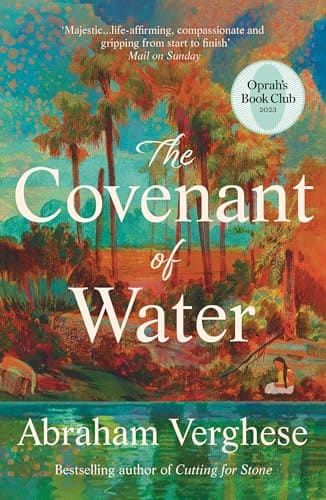
The Covenant of Water
From 1900 to 1977, a Saint Thomas Christian family on a Kerala estate called Parambil lives with a private terror: in every generation, at least one person drowns. A twelve-year-old bride grows into the matriarch known as Big Ammachi; a Glasgow surgeon washes up in Madras with burned hands; a granddaughter opens a skull and finally gives the family curse a medical name. Verghese's novel is a long, watery hymn to faith, caste, monsoon country, and the stubborn work of medicine.
“This is the covenant of water: that they're all linked inescapably by their acts of commission and omission, and no one stands alone.”
Complete free book club kit
BookClubee may earn a commission from Bookshop.org purchases, which supports independent bookshops.
Plan your meeting
Spoiler warning — best after finishing the book
The Covenant of Water Discussion Questions
20 free questions written for The Covenant of Water. No obvious right answers — built to spark real disagreement.
1. The novel opens with a twelve-year-old bride traveling by boat to marry a forty-year-old widower she has never met. Did you read that opening primarily as historical fact you had to accept, as a wound the rest of the book tries to heal, or as something the story never fully reckons with?
Warm Up
2. JoJo coins "Big Ammachi" for a stepmother barely older than a child herself. Does that nickname feel like love arriving early — or like the house already assigning her a job?
Warm Up
3. Before anyone has a diagnosis, the family talks about "the Condition" and keeps a Water Tree of drownings, water-aversion, deafness, and dizziness. Is that folklore protecting them, or is it the only science they have?
Warm Up
4. Digby leaves Glasgow for the Indian Medical Service because anti-Catholic bias and class block his surgical training at home. Do you buy that as vocation — or as a man running from his mother's death as much as from Scotland?
Warm Up
5. Philipose and Elsie marry as a writer and a painter who promise to respect each other's work. Early on, whose creative life did you take more seriously, and what in their behavior made you choose?
Warm Up
6. After JoJo drowns in an irrigation ditch, Big Appachen tells Big Ammachi they must still give children full lives despite the water. Is that courage, fatalism, or a refusal to change how Parambil is run?
Debate Starter
7. Digby testifies against Claude Arnold after a patient's death and wrecks his prospects with the British medical establishment. Would you have testified knowing it would exile you — or kept your head down and operated another day?
Debate Starter
8. Elsie stages a drowning, leaves Mariamma with Philipose and Big Ammachi, and goes to Saint Bridget's once she recognizes leprosy. Is that the most loving choice available in that place and time, or an abandonment dressed up as protection?
Debate Starter
9. Philipose breaks both ankles trying to free Ninan from the plavu, then slides into opium while still answering to "father." After that, do you still read him as Mariamma's father in the ways that matter — or as a man the household has to work around?
Debate Starter
10. At the Maramon Convention, Uplift Master is hired to translate an American preacher's sermon and instead turns the crowd toward funding a hospital at Parambil. Is that holy improvisation — or a man using someone else's pulpit because the ends were good?
Debate Starter
11. Lenin Evermore chooses the communist underground; Mariamma chooses anatomy and a village hospital. Which response to Kerala's poverty and caste do you find harder to dismiss — and does the novel actually let them be equally serious?
Debate Starter
12. Optimists might say naming the Condition as neurofibromatosis type II is the book keeping its promise that medicine can bless what faith only endured. Pessimists might say too many people still drowned, and a diagnosis arriving in the 1970s is cold comfort. Which reading fits the ending you actually got?
Debate Starter
13. Joppan grows up as Philipose's closest friend and Shamuel's son — Pulayar, not landowner. Does the novel convince you their childhood love survives caste at Parambil, or does adulthood quietly convert Joppan into "uncle-figure who helps at the hospital"?
Debate Starter
14. Philipose knows Mariamma is not his biological child, never tells, and still raises her. After you learn that from his journals, does his silence look like grace — or like one more secret the Water Tree was already full of?
Debate Starter
15. Mariamma studies Philipose's brain, finds bilateral tumors on the auditory nerves, and finally gives the drownings a name. Does that scene feel like the novel's true climax — or like a medical solution that cannot touch what Elsie, JoJo, and Ninan actually lost?
Deep Dive
16. Today we have genetic counseling, MRI, and family-health questionnaires. If a Water Tree showed up in your extended family now, would you still understand why someone might hide a hereditary condition — or has the novel's secrecy become historically interesting but morally harder to defend?
Deep Dive
17. Saint Bridget's is where burned hands, leprosy, and a staged death can be lived without a town watching. What does it cost a society to need a place like that — and who in your own world still gets sent somewhere "out of sight"?
Deep Dive
18. Big Ammachi tells Mariamma, in spirit if not always in those words, that she carries the name even when the grandmother is gone. Is inheriting a name a blessing, a job, or a way the dead keep voting?
Deep Dive
19. Water baptizes, drowns, floods the paddy, cools a fever, and fills Kerala's canals. By the last page, is water in this book still a gift you would thank — or a force the family was foolish to make a covenant with?
Deep Dive
20. Philipose survives a train wreck, hears a child in the water, swims, and dies of the same disorientation that killed his kin. Is that death the Condition claiming him — or the one moment he chooses someone else's life over the fear that has ruled Parambil since 1900?
Deep Dive