
Historical Fiction · Free kit
Hamnet
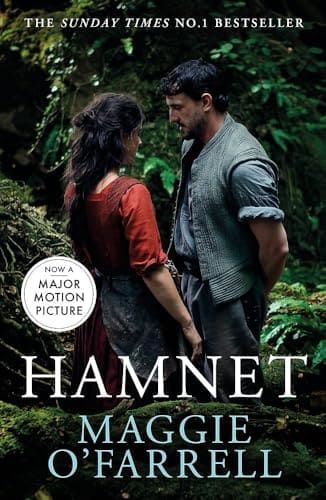
In 1590s Stratford-upon-Avon, a forest-raised healer named Agnes builds a life with a restless Latin tutor, their daughter Susanna, and twins Hamnet and Judith — while he chases a future on London's stages. In the summer of 1596, plague reaches an ordinary English door. Maggie O'Farrell's Women's Prize-winning novel is a sensory portrait of marriage, motherhood, and a boy whose short life would lend its name to a play. A 2025 film followed; this kit is for the book.
“Every life has its kernel, its hub, its epicentre, from which everything flows out, to which everything returns.”
Complete free book club kit
BookClubee may earn a commission from Bookshop.org purchases, which supports independent bookshops.
Plan your meeting
Spoiler warning — best after finishing the book
Hamnet Discussion Questions
20 free questions written for Hamnet. No obvious right answers — built to spark real disagreement.
1. Agnes chooses the Latin tutor despite Joan, the age gap, and the glover's cramped household. What did she see in his hand that made the risk feel necessary — and would you have trusted that kind of certainty?
Warm Up
2. The husband is never given the famous name you arrived with. Did withholding it help you see a Stratford son and absent father first — or did you fill in the playwright anyway, and what did that do to the story?
Warm Up
3. Agnes delivers Susanna in the forest after dreaming her mother's line about dense branches and rain. Was that courage, superstition, or the only place she felt she belonged?
Warm Up
4. Hamnet runs through two empty houses looking for help while Judith burns with fever. Which absence stung most: Agnes in her physic garden, the father in London, or a household that should have been home?
Warm Up
5. Agnes and Bartholomew can almost speak without words. Who in your life has that kind of shorthand — and what does the novel suggest it costs when a marriage does not?
Warm Up
6. Agnes conspires with Bartholomew to send her husband to London while she stays in Stratford with the children. Was that the most loving thing she could do for him — or the moment she agreed to live the rest of the marriage alone?
Debate Starter
7. After the funeral, the husband leaves again within days. Optimists: he had to go or grief would swallow him. Pessimists: he left Agnes to carry the body of the loss. Which reading fits the man we actually met?
Debate Starter
8. Hamnet crawls into Judith's bed, swaps clothes, and tries to take her place when Death comes. Do you read that as a child's magical thinking, a genuine spiritual bargain the novel asks you to believe — or both, and does it matter which?
Debate Starter
9. Agnes is more than a mile away in her garden of medicinal herbs when Judith falls ill. Should we hold a healer-mother responsible for not being home — or is that just grief looking for someone to blame?
Debate Starter
10. When Agnes learns there is a London play bearing her son's name, she is furious before she has seen a single scene. Is that fair — or the only honest response to a dead child being turned into public entertainment?
Debate Starter
11. Mary wants births in the house, with witnesses and a midwife; Agnes wants the forest. Whose version of care is actually safer, and who is trying to control whom?
Debate Starter
12. Optimists might say the husband's play is the only gift he had left to give. Pessimists might say he processed his grief on a stage instead of in his marriage. Which costs more — and to whom?
Debate Starter
13. John Shakespeare's house is crowded with gloves, debt, and fear. How much of the husband's leaving is about language and stages, and how much is about never becoming his father?
Debate Starter
14. Judith lives and Hamnet dies. Does the novel let you feel relief for Judith, or does survival become its own unpayable debt — especially for a twin who watched the bargain happen?
Debate Starter
15. Agnes believed she would have two children who lived long lives — then the twins arrived as a third life she had not seen coming. How should we read her gift: as true sight she misinterpreted, or as a story she told herself to feel safe?
Deep Dive
16. The plague reaches Stratford through a monkey, a flea, rags, and a box of Venetian glass beads. Why tell the disease as a chain of ordinary accidents across a trading world — and what does that echo for readers who lived through a pandemic of their own?
Deep Dive
17. At the play, Agnes understands that her husband has taken the Ghost's place so a boy named Hamlet can walk and speak. Does art that resurrects a child in public ever count as being there for the family that buried him?
Deep Dive
18. The novel is named for the child, but Agnes is the consciousness we live inside. Whose story is this, really — and what would change if the husband narrated the same years?
Deep Dive
19. Gendered labor runs through every room: she stays, he goes; she nurses, he writes; she buries, he performs. Is the book arguing that this split was inevitable in 1596, or that it is a choice couples still make when one person's work lives in another city?
Deep Dive
20. After the final scene, has anything actually been repaired between Agnes and her husband — or have they only found a language in which they can stand in the same room again?
Deep Dive