
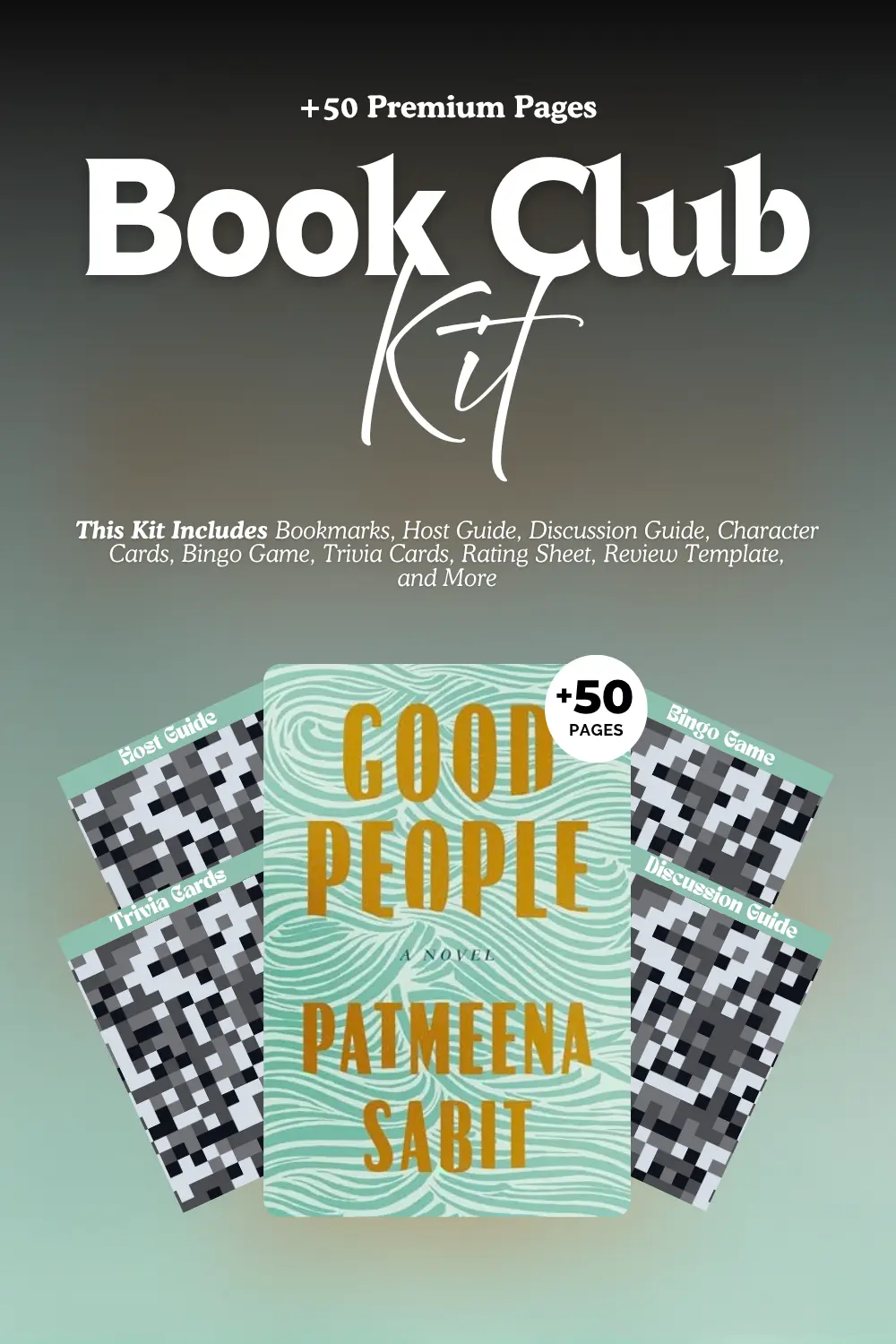
Literary Fiction · Free kit
Good People
A gripping novel about family, reputation, and the stories communities tell when tragedy strikes. When the Sharaf family’s carefully built American Dream collides with suspicion and scrutiny, everyone claims to know who they are — and almost no one agrees.
“A girl's reputation is never just hers. In it she holds the name of her whole family... For good people, name is everything.”
Complete free book club kit
Full printable kit — free to download.
Spoiler warning — best after finishing the book
Good People Discussion Questions
20 free questions written for Good People. No obvious right answers — built to spark real disagreement.
1. When Rahmat discovers Zorah has been forging her report cards, was taking away the France trip a reasonable consequence — or the moment he stopped treating her like a daughter and started treating her like a project?
Warm Up
2. Zorah tells her parents she wants to become a makeup artist instead of following the prestigious future Rahmat has planned. Whose dream do you find easier to understand: hers or his?
Warm Up
3. Omer follows Zorah when he suspects she's lying about where she's going. Does that feel more like an older brother looking out for his sister or someone who doesn't trust her to run her own life?
Warm Up
4. Zorah chooses to be with Sahil despite knowing exactly how much trouble the relationship will cause at home. Do you read that choice primarily as courage, impulsiveness, or something else?
Warm Up
5. Rahmat works relentlessly to give his children opportunities he never had, yet those opportunities come with very specific expectations. At what point does "I sacrificed for you" become an unfair debt?
Warm Up
6. Rahmat's statement that he would rather kill Zorah than let her marry Sayed's son becomes enormously important after her death. How much weight should we give words said during an explosive family argument?
Debate Starter
7. Zorah runs away, reports abuse, and later returns to her family after her relationship with Sahil falls apart. Does returning home make you reconsider her earlier accusations, or does it simply show how complicated an abusive or controlling family relationship can be?
Debate Starter
8. The Sharafs initially resist aspects of the reopened investigation and then hire Richard Ward. If you were a neighbor watching this unfold, would their legal strategy make you more suspicious or more sympathetic? Why?
Debate Starter
9. Sayed uses Rahmat's earlier remark to encourage suspicion that the family killed Zorah, partly after Rahmat humiliates him by rejecting the proposed marriage. Is Sayed exposing something important — or exploiting a tragedy to settle a personal score?
Debate Starter
10. The Afghan American community initially closes ranks around the Sharafs when accusations and harassment escalate. Is that solidarity admirable, or does defending "one of our own" risk preventing uncomfortable questions?
Debate Starter
11. Rahmat's determination to buy a home in an exclusive neighborhood represents his version of achieving the American Dream. Given what happens to the family, do you see that ambition as inspiring — or as the beginning of a trap?
Debate Starter
12. Optimists might say Rahmat's strictness comes from love and fear of losing his children; pessimists might say love doesn't make control less damaging. Which side has the stronger case after watching his relationship with Zorah?
Debate Starter
13. Optimists might argue that the community's decision to protect the Sharafs shows people can overcome gossip and prejudice when it matters. Pessimists might see it as proof that communities protect their own until doing so becomes inconvenient. Which interpretation fits the novel better?
Debate Starter
14. Optimists might say the lack of charges against the Sharafs demonstrates that institutions ultimately resisted public hysteria. Pessimists might say that by then, the family's reputation and life had already been destroyed. Which outcome matters more?
Debate Starter
15. The novel never lets Zorah speak directly for herself. Does that make you more careful about judging her — or more frustrated because you feel you've been denied the one testimony that matters most?
Deep Dive
16. Imagine today's social-media environment applied to the Sharaf case: would the family's story have received more public support, or would short clips, accusations, and outrage have made the situation even more extreme?
Deep Dive
17. The accusations of an "honor killing" collide with accusations of anti-immigrant and Islamophobic prejudice. How should people investigate genuine concerns about cultural violence without turning an entire immigrant community into suspects?
Deep Dive
18. The case becomes a media spectacle built from fragments: witnesses, rumors, police reports, and competing recollections. What does this suggest about how today's true-crime culture treats real people's suffering?
Deep Dive
19. Zorah's death leaves everyone constructing a version of who she was — rebellious daughter, beloved child, troubled teenager, victim, or something else. Why are people so uncomfortable admitting that a person can be several contradictory things at once?
Deep Dive
20. By the end, the question isn't simply whether the Sharafs are "good people," but whether being good can coexist with controlling someone you love, protecting your reputation, judging outsiders, or getting things terribly wrong. Is "good person" actually a useful moral category — or does the novel convince you that it's dangerously simplistic?
Deep Dive